


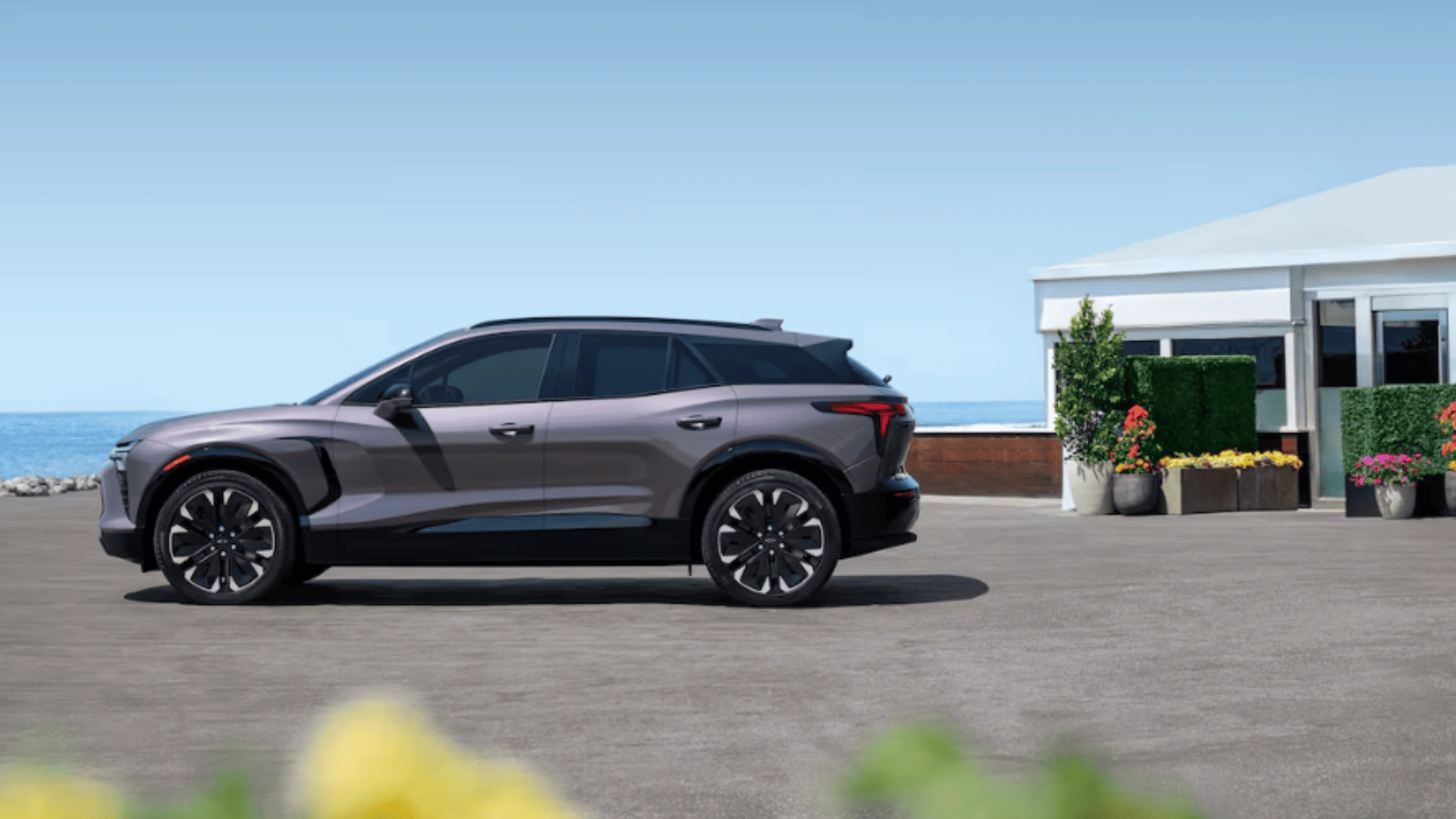
The 2025 Chevrolet Blazer EV introduces a combination of advanced electric propulsion systems and precision-engineered components designed for consistent power delivery and efficiency. Built on the latest EV architecture of Chevrolet, the 2025 Chevrolet Blazer EV demonstrates an evolution in drivetrain flexibility, energy management, and chassis design. Each trim, LT, RS, RWD, and SS, reflects a distinct configuration, ensuring performance characteristics suited to different driving demands. With new updates including enhanced power outputs, expanded range estimates, and additional equipment options, the 2025 Chevrolet Blazer EV continues to redefine how an electric midsize SUV performs in day-to-day operation.
Integrated Technology and Safety Systems
The 2025 Chevrolet Blazer EV incorporates a wide selection of driver assistance and active safety systems designed to improve awareness and reduce the potential for collisions. Standard Chevy Safety Assist includes Automatic Emergency Braking, Front Pedestrian Braking, Lane Keep Assist with Lane Departure Warning, Forward Collision Alert, Following Distance Indicator, and IntelliBeam® Auto High Beams. Additional safety equipment includes a Tire Pressure Monitoring System with tire fill alert, Safety Alert Seat, and Rear Seat Reminder for added awareness.
An available Convenience and Driver Confidence Package expands functionality with Adaptive Cruise Control, Rear Pedestrian Alert, Side Bicyclist Alert, Enhanced Automatic Emergency Braking, Intersection Automatic Emergency Braking, Reverse Automatic Braking, and HD Surround Vision. The RS trim offers an optional Head-Up Display and Rear Camera Mirror, while Super Cruise® hands-free driving capability is available on LT and RS AWD and standard on the SS trim. These systems combine to create an adaptive driving environment that supports both comfort and operational precision.
Electrified Powertrain Configurations
The 2025 Chevrolet Blazer EV provides multiple drive options, each tuned for a specific balance of traction, torque, and handling. The Front-Wheel-Drive (FWD) model uses a single permanent-magnet drive motor that delivers 220 horsepower and 243 lb-ft of torque. This setup prioritizes predictable power distribution and energy efficiency while maintaining a steady driving character. The powertrain's 11.59:1 final drive ratio contributes to strong initial acceleration and reliable traction on varying surfaces.
The All-Wheel-Drive (AWD) system enhances performance through a dual-motor design, pairing a bar-wound permanent-magnet motor in the front with an induction motor at the rear. Combined, these motors produce 300 horsepower and 355 lb-ft of torque, supported by front and rear final drive ratios of 11.59:1 and 10.99:1, respectively. This configuration improves cornering stability and delivers confident control through dynamic torque allocation between axles.
For those seeking performance-oriented dynamics, the Rear-Wheel-Drive (RWD) variant provides 365 horsepower and 325 lb-ft of torque using a single permanent-magnet motor and 11.63:1 final drive ratio. It offers responsive acceleration while optimizing range efficiency through reduced drivetrain drag. The RWD model achieves an EPA-estimated 334 miles, demonstrating the benefits of streamlined mechanical design and larger battery capacity.
At the top of the range, the 2025 Chevrolet Blazer EV SS employs a dual-motor layout generating 615 horsepower and 650 lb-ft of torque when Wide Open Watts mode is activated. The front and rear drive ratios of 9.87:1 and 10.49:1 provide rapid acceleration and direct power transfer. The SS configuration showcases engineering focus of Chevrolet on high-output performance without sacrificing precision or control.

Battery Systems and Charging Capabilities
Energy storage in the 2025 Chevrolet Blazer EV is managed by a high-density lithium-ion NCMA system composed of multiple linked modules. Depending on configuration, the system delivers 85 kWh of rated energy for FWD and AWD models and 102 kWh for RWD and SS trims. This variation allows the 2025 Chevrolet Blazer EV to balance weight, range, and power output across its lineup. The battery chemistry ensures stable temperature control, consistent discharge characteristics, and long-term durability under high-load operation.
Charging flexibility remains one of the defining strengths of the 2025 Chevrolet Blazer EV. The vehicle supports AC charging at up to 11.5 kW, which provides efficient overnight replenishment for typical commuting distances. When connected to a DC fast charger, charging capacity increases to 150 kW for the 85 kWh battery and 190 kW for the 102 kWh system. Under optimal conditions, the RWD model can regain up to 87 miles of range in ten minutes, while the FWD, AWD, and SS versions add approximately 81, 68, and 79 miles, respectively, within the same time frame. These capabilities minimize downtime and enhance long-distance travel convenience.
Approximate charge rates vary by power source. A standard 120V outlet yields around four miles of range per hour, while a 240V dual-level charge cord provides approximately 25 miles per hour for FWD configurations, 22 for AWD and RWD, and 20 for SS. When connected to a dedicated 11.5 kW charging system, the FWD trim adds about 35 miles of range per hour, with slightly reduced rates for the higher-performance models.
Disclaimer: Professional installation required. Actual charge times will vary based on battery starting state of charge, battery condition, output of charger, vehicle settings and outside temperature.
Range Efficiency and Driving Endurance
The range figures of the 2025 Chevrolet Blazer EV underscore the brand's focus on usable distance and energy optimization. EPA-certified estimates list 312 miles for FWD, 283 miles for AWD, 334 miles for RWD, and 303 miles for the SS. Each configuration reflects precise tuning of drivetrain efficiency and regenerative braking calibration. The aerodynamic profile and advanced thermal management system help sustain these range figures under a wide range of operating conditions.
Structural Design and Handling Precision
Chassis construction in the 2025 Chevrolet Blazer EV emphasizes rigidity and balance. All trims feature a five-link independent suspension system at both front and rear axles, engineered for consistent handling over uneven surfaces. Steering is controlled by a Continuously Variable Electric Power Steering (EPS) mechanism calibrated for smooth feedback and responsive direction changes. The steering ratio is 18.46:1 for FWD, AWD, and RWD models and 15.8:1 for the SS trim, enabling sharper responsiveness during high-performance driving.
Braking systems are uniform across the lineup, utilizing four-wheel disc brakes for dependable stopping performance. The SS trim includes Brembo® six-piston fixed calipers with 15.3-inch front rotors, providing greater heat resistance and stopping stability. Other models feature 12.5-inch front and 13.6-inch rear rotors designed for consistent braking force across extended use.
The steering and suspension geometry of the 2025 Chevrolet Blazer EV contribute to a 39.7-foot turning circle, providing maneuverability suitable for both city driving and confined spaces. Ride comfort is enhanced by a low-mounted battery system that lowers the vehicle's center of gravity, improving weight distribution and cornering stability without sacrificing ground clearance.
Dimensions and Exterior Characteristics
With a 121.8-inch wheelbase and overall length between 192.2 and 192.6 inches, the 2025 Chevrolet Blazer EV maintains proportions that emphasize stability and space efficiency. The overall width measures 78 inches without mirrors and 86.5 inches with mirrors. The height ranges from 65 inches on standard models to 64.8 inches on the SS, reflecting subtle aerodynamic refinements. Ground clearance varies slightly between trims, from 8.0 inches on FWD to 7.5 inches on SS, allowing for balanced capability and handling.
Tire and wheel dimensions reinforce each vehicle's purpose. The LT trim features 19-inch aluminum wheels with 255/60R19 tires, while the RS includes 21-inch wheels with 275/45R21 tires. The SS trim carries 22-inch wheels with 275/40R22 tires, maximizing grip and enhancing braking stability. For the 2025 Chevrolet Blazer EV, Chevrolet has introduced a Midnight Package and Sport Package on the LT trim and two-tone roof options for the LT and RS, providing subtle exterior customization choices. A new Habanero Orange color joins the palette, further distinguishing the 2025 Chevrolet Blazer EV.
Interior Specifications and Cabin Space
Interior dimensions have been engineered for balanced passenger comfort and cargo functionality. The first-row headroom measures 40.9 inches without a sunroof and 39.4 inches with one, while the second row provides 38.1 inches without and 36.7 inches with a sunroof. Front legroom extends to 44.2 inches, and rear legroom measures 38.9 inches, ensuring consistent space allocation for both seating rows. Shoulder room measures 58.7 inches in front and 58.3 inches in the rear, with hip room at 57.4 inches in front and 53.8 inches in the rear. Cargo volume reaches 59.1 cubic feet with the rear seats folded, or 25.5 cubic feet with the rear seats upright, depending on roof configuration.
Base curb weight varies by drivetrain, ranging from 5,009 pounds for FWD to 5,730 pounds for SS. The RWD configuration supports a maximum trailering capacity of 3,500 pounds, while FWD and AWD models are rated for 1,500 pounds. The SS is optimized exclusively for performance and is not rated for towing applications.
Schedule a Test Drive at Powers Swain Chevrolet
The 2025 Chevrolet Equinox EV demonstrates how precision engineering and practical design can coexist within an electric platform built for reliability and range consistency. Its structured performance, efficient battery composition, and durable suspension architecture position it as a dependable electric option for daily and extended use. To experience the performance, interior layout, and advanced electric systems firsthand, schedule a test drive at Powers Swain Chevrolet near Fort Bragg, NC. Discover how its consistent torque delivery, fast-charging capability, and refined structural balance combine to form a complete electric crossover ready for every drive.
Make an Inquiry
* Indicates a required field